Thursday, 16 August 2018

Guillermo del Toro: A Modern Appreciator of Curiosities

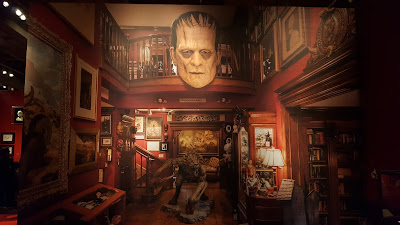
A recent special exhibition at the Art Gallery of Ontario featured a re-creation of Guillermo del Toro’s personal collection of memorabilia, paintings, and sculpture, mostly related to monsters and various forms of monstrosity. Del Toro, perhaps best known as the academy award winning writer and director of The Shape of Water (2017), has amassed a large collection which he has fashioned as a private "cabinet of curiosities," a space (spanning two houses in Southern California) designed to inspire his imagination and his work. He calls this home studio "Bleak House."[1] His mixing of temporal references is telling. In many ways, this collection, which expresses a single-minded interest in monsters and related Gothic themes, owes as much to the nineteenth-century and early-twentieth century as it does to the late Renaissance context of the cabinet of curiosities, with all of its variety and diffuse interests. Nonetheless, despite any obvious point of direct reference to the historical origins of the cabinet of curiosities, there were a number of elements in del Toro’s collection that evoke this context of these prototypical museums. The entrance to the exhibition (a replica of one of del Toro’s houses) evokes rooms like that of Olaus Worm, seemingly bursting with objects in every nook and cranny.

Entrance to the At Home with Monsters exhibition, AGO, Toronto


A representation of Olaus Worm's museum, Copenhagen
(Musaeum Wormianum, 1655).
Similarly, for Del Toro, like many early modern collectors, the collection space is also a work space, a place of inspiration and information: this is where he does his working and creating. It is a mixture of forms, of high and low, natural and (mostly) artificial. It delights in the exceptional, the uncanny.

DDT Efectos Especiales Phasma
Gigos (Insect), 2006.


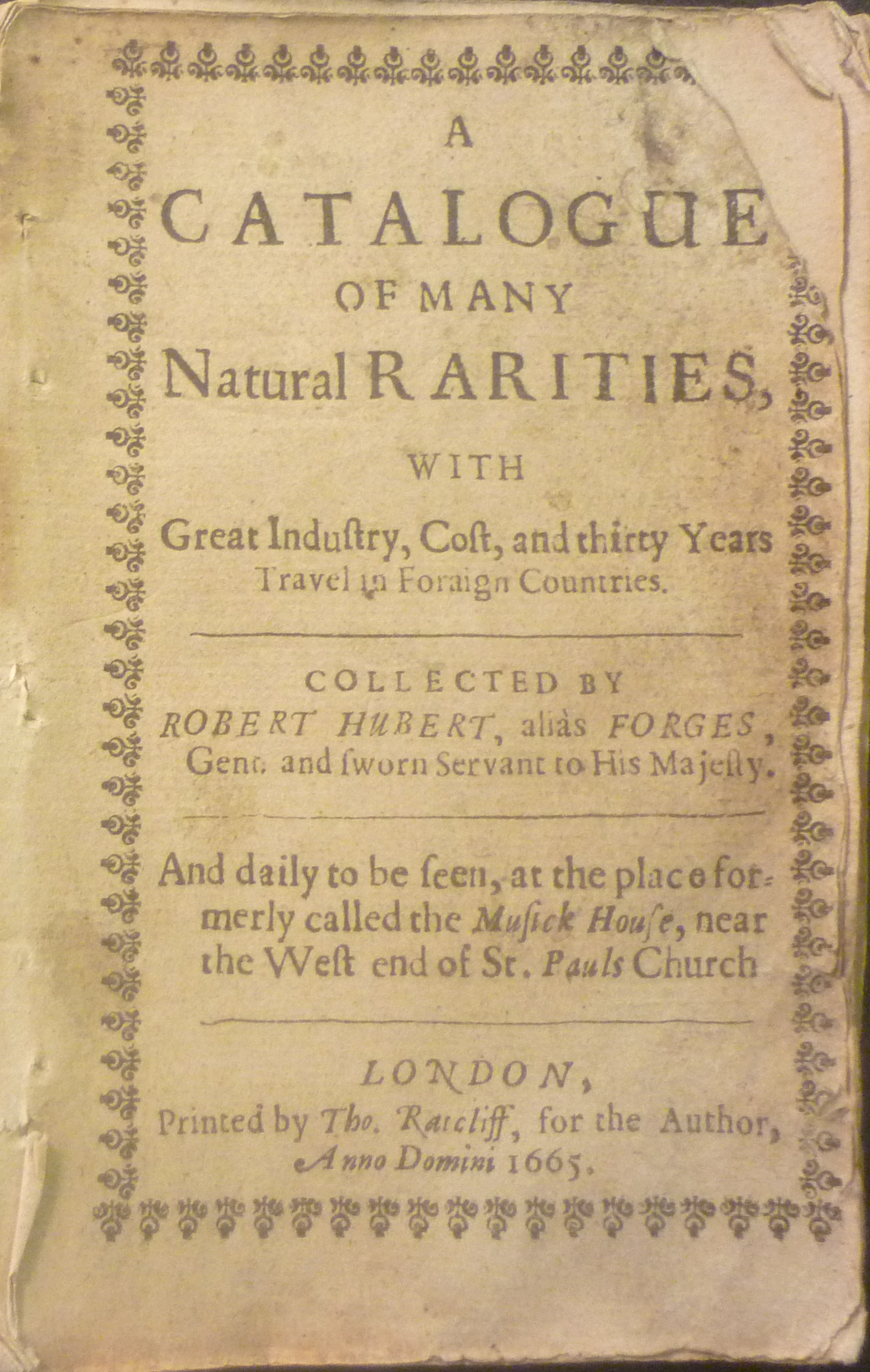
We see a common interest in what seem to be exceptional specimens of nature: in Robert Hubert’s seventeenth century collection, “A great flying-fish or Sea-Swallow, that flyes sometimes aboard the ships”; flying Squirrel, a little Beast of Virginia, that flyes from Tree to Tree, by extending of its skin on either side; or “A Guiney flie bigger than a Sparrow” (1665).


Emilie Steele. Escape, 2016.
We see also a fascination with ingenious compositions blending the natural and the artificial: Sir Walter Cope’s “handsome cup made out of goosefoots from China” or “A Madonna made of Indian feathers” (c. 1599. Platter, 171, 173).

With respect of del Toro’s chosen theme, in the strange world of the early modern cabinet of curiosities, monsters gained new significance, representing in an explicit way the category confusion created by a new, wide world of objects that defied traditional, received categories. A passage from Francis Bacon can set the stage for the place of monsters and other forms of aberration in the attempt, in the new, empirical mode of knowledge, to re-examine traditional taxonomies. Bacon was a collector of facts through observation. Voyages of discovery were, therefore, crucial to the new philosophy. For Bacon, “Distant voyages and travels have brought to light many things in nature, which throw fresh light on human philosophy and science and correct by experience the opinions and conjectures of the ancients” (Refutation, 131). The world on the edges of knowledge and experience was a place of possibility. Here, that which was encountered and could not be fit into the established models of the world were rendered marvelous; but at the same time, for those who, in the Baconian tradition, began with an assumption that the old, received paradigms needed to be exploded, to be replaced by new taxonomies built on observation, these category-defying objects were particularly interesting. For this reason, Bacon holds a special place for monsters, the “heteroclites and irregulars of nature,” which force us to reconsider neat ontological categories. In his Advancement of Learning, Bacon sets out three aspects to his proposed project of a new History of Nature: “of nature in course, of nature erring or varying, and of nature altered or wrought” (3.330). He advocates the need for “a substantial and severe collection of the Heteroclites or Irregularities of nature, well examined and described.” The benefit of such a collection is to “correct the partiality of axioms and opinions, which are commonly framed only upon common and familiar examples” and to learn form “the wonders of nature … the nearest intelligence and passage toward the wonder of art” (3.331). Deviations of nature hint at possibilities in human manipulation of nature. Now, to be clear, Bacon is talking about a collection in histories, that is, written accounts, but the same principals apply, presumably, to the collection and examination of the objects themselves.

Early modern collections clearly expressed this interest in hybridity, of variations from natural form, and even human manipulations of nature, a mixing of the natural and artificial:
• “A Monstrous Calf, with two Heads, and two Tayles, with a perfect Body” and “A Gyants Thigh bone 4 foot long” in Robert Hubert’s collection (1665).
• A “round horn which had grown on an English woman’s forehead” or “An embalmed child (Mumia)” in Sir Walter Cope’s collection (Platter, 172).

Unknown. Anatomical Model of Conjoined Babies

The famous prose writer and Norwich physician, Sir Thomas Browne, himself a collector of curiosities and an experimenter and expositor of nature in the Baconian tradition, goes beyond mere empirical interest to posit the beauty in the monster. In his Religio Medici (1642), Browne writes,
I hold there is a general beauty in the works of God, and therefore no deformity in any kind or species of creature whatsoever. … there is no deformity but in monstrosity, wherein notwithstanding there is a kind of beauty, Nature so ingeniously contriving the irregular parts, as they become sometimes more remarkable that the principal fabric. To speak yet more narrowly, there was never anything ugly, or misshapen, but the chaos; wherein notwithstanding to speak strictly, there was no deformity, because no form, nor was it yet impregnate by the voice of God. Now nature is not at variance with art, nor art with nature; they being both servants of providence (I.16). 
Here, perhaps, we come close to del Toro’s interest in monsters. Near the end of the exhibit, at a station titled "May the Monsters Follow you Home," del Toro elaborates his parting benediction: "Monsters speak to a very deep spiritual part of ourselves and the way we construct our place in the universe."


Notes:

[1] Guillermo del Toro: At Home with Monsters. Art Gallery of Ontario, Sept. 30, 2017 – Jan. 7, 2018. https://ago.ca/exhibitions/guillermo-del-toro.

Works cited:


Bacon, Francis. The Philosophy of Francis Bacon: An Essay on Its Development from 1603 to 1609, with New Translations of Fundamental Texts. Edited and translated by Benjamin Farrington. [Liverpool]: Liverpool University Press, 1964.
Browne, Thomas. The Works of Sir Thomas Browne. Edited by Geoffrey Keynes. 6 vols. London: Faber & Faber, 1964.
-------. The Works of Francis Bacon. 7 vols. Edited by James Spedding, Robert Leslie Ellis, and Douglas Denon Heath. London: Longmans, 1870.  
Hubert, Robert. A Catalogue of Many Natural Rarities, with Great Industry, Cost, and thirty Years Travel in Foraign Countries. Collected by Robert Hubert, aliàs Forges, Gent. and sworn Servant to His Majesty. And daily to be seen, at the place formerly called the Musick House, near the West end of St. Pauls Church (1665). Edited by Brent Nelson. Digital Ark. http://drc.usask.ca/projects/ark/XML/Hub1665/. 
Platter, Thomas. Thomas Platter's Travels in England 1599. Edited and translated and edited by Clare Williams. London: Jonathan Cape, 1937.  Digital Ark. http://drc.usask.ca/projects/ark/XML/CopePlat/.
Worm, Ole, et al. Museum Wormianum: Seu Historia Rerum Rariorum, Tam Naturalium, Quam Artificialium, Tam Domesticarum, Quam Exoticarum, Quæ Hafniæ Danorum in Ædibus Authoris Servantur. Leiden and Amsterdam, 1655.

Tuesday, 29 May 2018

SSHRC funding for phase two: The Social Network of Early Modern Collectors of Curiosities

We are pleased to announce that we have received funding from the Social Sciences and Humanities Research Council of Canada / Conseil de recherches en sciences humaines to support the next phase of our research, titled "The Social Network of Early Modern Collectors of Curiosities." Our research team for this project is Brent Nelson (University of Saskatchewan, PI), Craig Harkema (University of Saskatchewan, Co-Applicant), Lisa Smith (University of Essex, Collaborator), and Jon Bath (University of Saskatchewan, Collaborator). Here is a description of what we plan to get up to over the next three years.

Project Summary

The scholarly literature on early modern networks of collectors and collections of curiosities (precursors of the modern museum) has thus far focused on the fact of exchange: who knew and exchanged objects with whom. Similarly, network analyses of databases and documents related to early modern social and intellectual networks have employed visualizations of people and their relationships, but not to objects. This program of research intends to put a GoPro on the object, to follow these objects through these networks of exchange, moving beyond the mere fact of exchange and who knew whom within these relationships to consider the objects themselves and how they were exchanged, understood, and regarded in their changing circumstances. Focusing on an extensive body of archival materials related to collections of curiosities in England and Scotland from 1580-1700 (the "Digital Ark" described below), our research will examine the composition and function of these networks of exchange, tracing the "life stories" or "biographies" of curious objects as they travelled through these social networks. For example, one such exchange involved a strange stone voided by "a poor girl at Rawden" donated by one Dorothy Ward, a citizen of Leeds, to the collection of Ralph Thoresby, a prominent merchant of that city and Fellow of the Royal Society. In another event, a stone "in the shape of a heart, voided by an ancient person at Ardsley" was sent to Thoresby by a Captain West "with an attestation under the hand of the surgeon." In tracing these events of exchange, we will ask such questions as: Who were the people involved in these collecting networks, and from what social groups or classes? What was their relationship to these exchanged objects, and what were their roles in the production, acquisition, and exchange of these objects? And what does all this tell us about the function of collected objects in the cultural and intellectual practices of these social networks?

To answer these questions, we will model and develop new applications of computer-assisted network analysis to a large corpus of materials aggregated in the Digital Ark: an archive of surviving records of early modern collections comprised of some three dozen documents in print and manuscript, totaling over 750,000 words of text, including catalogues, inventories, and lists of collections, as well as descriptions of collections in travel accounts and diaries. These documents have been transcribed and encoded in XML (eXtensible Markup Language) and connected to a relational database of associated people, places, images, and bibliographic sources. In this phase of our research, we will develop methods of linking entities referenced in this material--not only mentioned people and places, but also the objects themselves--and of identifying and articulating the relationships between them. With these linkages in place, we will adapt and apply methods of network visualization to this linked data. What we expect to reveal is a complex network of participants, from across a wide range of social sectors, involved in a wide range of capacities in the production, transmission, acquisition, and observation of objects, and thus many different kinds of relationships between people and objects.

Monday, 15 January 2018

Strange Fish: an opening gambit

I recently spotted this curiosity in the window of a basement apartment in Saskatoon, looking as if it had escaped from a cabinet somewhere. Varieties of the puffer-fish were popular items for collection in the early modern period. Nehemiah Grew, in his catalogue of the Royal Society’s collection Musaeum Regalis (1681), lists a couple of specimens in this vein. One of them is identified as:
The little GLOB-FISH. Orbis minor. So called from his Orbicular figure. Described in most Musæums. Most curiously figur'd in that of Calceolarius. He is armed with long, round, hard, and sharp Spikes or Needles all round about, almost like those of a Hedg-Hog; and is a sort of Porcupine-Fish. 'Tis probable, That the Fish swims with these Needles all closely couched down round about, for that otherwise they would hinder her swimming. But if at any time she is pursu'd, she immediately advances her Pikes, and bids the enemy come at his peril. (sig. [Pv]-P2)
Grew cites Italian collector Francesco Calzolari (1522-1609) (actually, Benedicto Cerutin and Andrea Chiocco, who compiled the catalogue of his collection) for providing a “curious” figure of this fish. Two specimens are also visible hanging from the roof of his “cabinet.”

Images of Calzolari's collection and image of the porcupine fish,
from Benedicto Cerutin and Andrea Chiocco, Musaeum
 Franc. Calceolari Jun.
(1622), fold-out and sig. N2.


Grew also lists separately a “Sea-Porcupine,” citing this time Jan Jonston’s illustration in his Historiae naturalis de piscibus (1650).

Jan Jonston, Historiae naturalis de piscibus (1650), Tab. 45.

It is sometimes difficult to sort out the nomenclature for natural specimens in these collections, owing to naturalists’ and collectors’ habit of naming species by analogy: for example, the “tobaccopipe fish” (with a long, slender body, “from whence its name” says Grew) or the “swallow fish” for a flying fish. The pufferfish, blowfish, globefish, and balloonfish (to name only a few variants) all belong to the “tetraodontidae” family, so named (says Wikipedia) for their four large teeth fused into an upper and lower plate. But in the minds of early modern naturalists and collectors, these fish were associated because they have in common an inflatable body. But while the porcupine fish is closely related and was often, in such collections, conflated with these other expandable, globous fish, it is not actually part of the same family.

Strange fish of all kinds continue to fascinate, in part for all the strange shapes they come in and the comparisons they inspire. They also fascinated then, as now, because they came from a place that is utterly remote to most human experience, a natural black-box yielding a variety of unusual and surprising forms, and then only reluctantly. Watch this space for further explorations of strange fish from the cabinet of curiosities.

Thursday, 28 December 2017

New publication and project documentation

The project has a new publication, on "Curating Object-Oriented Collections Using the TEI," recently appearing in the Journal of the Text Encoding Initiative. In it, I provide a framework for tagging material objects in documents using the TEI guidelines, which forms the basis for our own approach in the Digital Ark. Here is the abstract:
This article considers the possibilities and challenges in using TEI-based XML markup for curation of objects mentioned in historical documents such as catalogues and inventories, but also in unstructured forms such as diaries and personal correspondence. It takes as a case study documents related to early modern collections of curiosities. It first considers how far the current guidelines for manuscript description can be generalized for encoding other kinds of material objects and their contexts. It then examines what more is required for treating mentions and descriptions of objects in historical documents. It argues that the core affordance of curation for such materials is the ability to identify and select what constitutes a mention of an object and to relate that mention to its immediate context, including its relationships to object groupings.
On the occasion of this publication, it seems a good time to draw together some documentation from this and our project Guidelines for preparing transcriptions to give a fuller account of how we are processing our documents in the Digital Ark. So, we have started a new page (a work in progress) where we will gather documentation for the project, starting first with transcription preparation, and then adding other relevant technical features. Over the next few months (with the benefit of a sabbatical leave), I hope to continue to update this document and provide other project updates.

Sunday, 5 March 2017

Gimcrack gets last laugh

They laughed at Sir Nicholas Gimcrack, a late-seventeenth-century virtuoso, for his scheme of bottling fresh air from around England, storing his stock like wine in a wine cellar, and then breaking it out on special occasions for the refreshment of special guests. Now, a company in Alberta is commercializing Gimcrack's idea, bottling air from the Rocky Mountains and selling it worldwide for $15 per bottle.
 

Gimcrack is a character in Thomas Shadwell's play The Virtuoso, performed by The Duke's Company at London's Dorset Garden Theatre in 1676. In it, Gimcrack is the butt of gibes and jokes by other characters for his many experiments and activities (including his collecting of curiosities) which very closely parallel the reported activities of members of the Royal Society of London. And London audiences laughed along at the crazy antics of this early modern egghead. Except Robert Hooke, fellow of the Society, who was not amused by the performance, clearly seeing himself behind the portrayal; however, it was probably Robert Boyle that Shadwell had in mind with this allusion. Boyle had built several air pumps and was experimenting with pressurized cylinders, and he had sent his agents to various sites to measure air pressure at different altitudes using an early form of barometer (from Tenerife to the Isle of Dogs). Shadwell's treatment of the Royal Society and the culture of curiosity is remarkably prescient in many respects, now very particularly so given a new enterprise by Vitality Air, recently reported by CBC Calgary. Like Gimcrack, who offers his guests choice of a variety of airs ("Gentlemen, what country air do you like best?" 4.3.231), Vitality Air comes in three flavours—grape, strawberry, and root beer—although it derives from only two locations, both in the Rocky Mountains of Alberta. Sir Nicholas Gimcrack, a man ahead of his time.

Friday, 4 November 2016

New Project on Sir Hans Sloane's Manuscript Catalogues

We are delighted to hear news of Enlightenment Architectures: Sir Hans Sloane's Catalogues of His Collections, a new research project based at the British Museum in collaboration with the Department of Information Studies at University College London, with funding from the Leverhulme Trust. Sir Hans Sloane was a a crucial figure in the history, marking the transition from the seventeenth-century collector of curiosities to an early modern builder of a museum that would become the monumental British museum. The project is led by Dr Kim Sloan as Principal Investigator, together with Co-Investigator Dr Julianne Nyhan and Senior Research Assistant is Dr Martha Fleming. The researchers provide this description of the project:
The objective of Enlightenment Architectures: Sir Hans Sloane’s catalogues of his collections is to understand the intellectual structures of Sloane’s own manuscript catalogues of his collections and with them the origins of the Enlightenment disciplines and information management practices they helped to shape. The project will employ a pioneering interdisciplinary combination of curatorial, traditional humanities and Digital Humanities research to examine Sloane’s catalogues which reveal the way in which he and his contemporaries collected, organised and classified the world, through their descriptions, cross-references and codes. The project will draw on the research framework that emerged from the 2012 AHRC-funded 'Sloane's Treasures' workshops, and findings will make significant contributions to histories of information science, histories of collections, and philosophy of knowledge, and will benefit a wide range of other disciplines as well.
The project will transcribe and analyze six major manuscript catalogues from 1680-1753 involving remnant collections held at the British Library, the British Library, and the Natural History Museum. Watch this space for notice of the project website, coming soon.

Wednesday, 16 December 2015

The Cabinet of Curiosities as Knowledge Environment

In my work on INKE: Implementing New Knowledge Environments (www.inke.ca), much of my focus was on the history of the book as a knowledge environment and its implications for the way in which we think about developing new, digital knowledge environments (see for example ArchBook). In my recently published article on "The Museum as Knowledge Environments", I pursue this idea in the context of museum history and the implications for delivery of museum content on the Web. In the early days of what would become the modern museum, the cabinet of curiosities was a site for the serious pursuit of knowledge. These were multi-faceted and dynamic environments, closely related and often integrated with other kinds of spaces for the pursuit of knowledge, including libraries, botanical gardens, laboratories, and other work spaces. The University of Leiden, for example, incorporated a cabinet of curiosity in its anatomy theatre. An English catalogue of this collection includes ethnographic objects ("Some Indian Darts"; "A Pair of Sandals or Slippers from the Kingdom of Siam"), remnants of exotic and strange animals ("The Hide of a Sea-Horse"; "A Little Box, wherein is some blood of a Crocodile") and the simply bizarre ("The Entrails of a Man of which is made a Shirt").

In the English context, the Royal Society's collection (or "Repository") served as a database of objects gathered, examined, and discussed by its members and associates in their meetings and their Philosophical Transactions. In this article, I focus on the interplay of textual and empirical modes of knowing as exemplified in a couple of cases from Nehemiah Grew's catalogue of the Royal Society's Repository as a basis for providing a framework for thinking about the representation of museum objects in new kinds of knowledge environments.


Abstract Early modern cabinets of curiosities (precursors of the modern museum) were sites for collecting and generating object-centred knowledge in the early days of empiricism, but they were equally dependent on text-based ways of knowing and disseminating knowledge. These collections thus provide an important historical point of reference for thinking about the possibilities of new knowledge environments for representing cultural heritage objects on the Web, which presents new possibilities for textual and visual representation. After elaborating the historical context of early modern collections as knowledge environments, this paper concludes with some principles for representing cultural heritage objects to support scholarship in the humanities.

See the full article in Scholarly and Research Communication.

Bibliography:

Blancken, Gerard. A catalogue of all the cheifest rarities in the publick theater and Anatomie-Hall, of the University of Leyden ... which are so set in order that all may easily bee found in their places. London, 1697.

Grew, Nehemiah. Musæum Regalis Societatis, Or, a catalogue & description of the natural and artificial rarities belonging to the Royal Society and preserved at Gresham College. London, 1681.

Nelson, Brent. "The Museum as Knowledge Environment." Scholarly and Research Communication 6.3 (2015): 1-15. http://src-online.ca/index.php/src/article/viewFile/225/438

Saturday, 31 October 2015

Modelling Multi-Level Engagement with Cabinets of Curiosities

The first question we should ask when putting cultural heritage material (or any material) on the Web is, what will the Web allow us to do that would be difficult in a different context? This question has been asked in the context of editing works of literature. In the context of work we did last year as part of the Digital Cultural Heritage team of GRAND (Graphics Animation and New Media), we directed this questions at museums, specifically, our digital archive of early modern museums. In our current context, the Web has presented opportunities to capture the attention and imagination of the general public (for some excellent examples, see Best of the Web hosted by Museums on the Web); but museums have not been so quick to enable equally empowering access to professional users, that is, scholars.

A significant factor in the contemporary "reinventing of the museum" as Gail Anderson articulates it is "the belief that a fundamental shift in ideology and practice is essential for museums to remain relevant and integral in a twenty-first-century world" (8). A major expression of this shift has been an increased emphasis on public engagement resulting, somewhat paradoxically, in a narrowing of the museum's imagined audience. In attempting to define just what a "museum" was in the year 1942, Theodore Lewis Low's first point of reference is telling: "the scholar thinks of the magnificent collections and perhaps of his favorite objects; the man on the street thinks of a huge pseudo-something-or-other building with pigeons flying above and peanuts on the side-walk in front" (35). In defining the activities of the mid-twentieth-century museum, Theodore Lewis Low turns to the three elements comprising Paul M. Rea's summary of the work of a museum: "the acquisition and preservation of objects, the advancement of knowledge by the study of objects, and the diffusion of knowledge for the enrichment of the life of the people" (36). Low complains that, in practice, there is a significant imbalance in the emphasis laid on these three elements: "The first two have forced the last to maintain a subordinate position" (36). Low's mid-century dismissive characterization (and disenfranchisement) of the unwashed masses was certainly in need of correction, but the correction has come at the cost of the other sort of user, the scholar. In her own reimaging of the post-modern museum, Fiona Cameron posits four user groups—curators, collection managers, educators, and non-specialists—none of them an obvious category for the "scholar" (330). The educator category focuses on pedagogy, leaning toward primary- and secondary-school students. The "non-specialist" is the visitor from the general public who typically approaches the museum collections, whether on-line or in physical space, as a form of diversion or entertainment (332).

And yet, interestingly, cabinets of curiosities—the precursors of the modern museum—often served the interests of several audiences at once. For one of the earliest collectors in the English context, John Tradescant the Elder (c.1570s-1638), collecting curiosities went hand-in-hand with his importation and experimentation with foreign plants in his famous gardens; while scholars and natural philosophers made use of his collection in their own research (MacGregor 22; see also Picciotto 288). Tradescant's collection was a favorite recreation of the nobility and others of the higher classes; but, significantly, it was also accessible to the general public and was appreciated for its educational value for children (MacGregor 23). A few decades later, in the seventeenth-century, Robert Hubert's museum near St. Paul's Cathedral was also open to the public (as advertised on the title page of his printed catalogues), and his collection would eventually make its way into the Repository (collection) of The Royal Society (Hunter 163). The Leeds antiquarian Ralph Thoresby (1658-1725), a Fellow of the Royal Society, kept an extensive museum and welcomed visitors to it from near and far. The early modern collection of curiosities was a site of discover for both the curious tourist and the serious scholar and researcher.

http://drc.usask.ca/projects/ark/media/HubertTP.jpg
Image courtesy of the Bodleian Library, Oxford University

We take this historical context as our cue for thinking about how we might represent our archive of early modern cabinets of curiosities for audiences of varying levels and kinds of interest. One special affordance of the Web is layering of content, and related to this, the ability to cater to more than one audience with the same content. As part of our work on GRAND, I asked PhD student and research assistant Jade McDougall to come up with a model for a multi-layered interface for exploring the Digital Ark, one that would satisfy both the curious tourist and the researching scholar. She chose to focus on the collection of John Bargrave (1610-1680), much of which is still extant at the Canterbury Cathedral. This is what she came up with.


This interface design for the collection was based, logically enough, on Bargrave’s pre-existing cabinet system. We wanted to bring the cabinets to life by allowing users to experience the sensation of exploring the various drawers, rummaging through them to find objects of interest. Because the user could potentially be moving through the drawers quickly or haphazardly, a layered approach that remains anchored to a particular cabinet—without having to click away to a different page every time the user wishes to access a drawer or look at an item—seemed a fitting solution. The spatiality of the cabinet, drawer and item could all be preserved, and the user would have no trouble maintaining a sense of where they are in the collection. For the sake of visual cleanliness, the screen is divided in two, with the right side dedicated to navigation and the left side to investigating items. Because the collection is geared toward interested general audiences, we chose to limit the amount of information available at the item overview level, using snippets to encourage users to click through and access more in-depth entries. By balancing a clean, attractive and engaging interface with extensive information and primary sources, we hope to capitalize on the curiosity of academics and non-academics alike, leading users from a sense of novelty and discovery to a deeper interest and engagement with the materials.

Anderson, Gail. Reinventing the Museum: The Evolving Conversation on the Paradigm Shift. Lanham, MD: AltaMira Press, 2012.

The Bargrave Collection. Canterbury Cathedral. https://www.canterbury-cathedral.org/bargrave/.

Best of the Web.  Museums on the Web. http://www.museumsandtheweb.com/best-of-the-web/.

Cameron, Fiona. "Digital Futures I: Museum Collections, Digital Technologies, and the Cultural Construction of Knowledge." Curator: The Museum Journal 46.3 (1 Jul 2003): 325–40. doi:10.1111/j.2151-6952.2003.tb00098.x.

Hunter, Michael. "The Cabinet Institutionalized: The Royal Society's 'Repository' and Its Background." In The Origins of Museums: The Cabinet of Curiosities in Sixteenth- and Seventeenth-Century Europe. Eds. O. R. Impey and Arthur MacGregor. Oxford: Clarendon, 1985. 159–68.

Low, Theodore Lewis. The Museum as a Social Instrument. [New York]: Published at the Metropolitan Museum of Art for the American Association of Museums, 1942.

MacGregor, Arthur, ed. Tradescant’s Rarities: Essays on the Foundation of the Ashmolean Museum, 1683, with a Catalogue of the Surviving Early Collections. Oxford: Clarendon Press, 1983.

Picciotto, Joanna. Labors of Innocence in Early Modern England. Cambridge, MA: Harvard University Press, 2010.

Rea, P. M. "What are Museums For?" Journal of Adult Education 2 (June 1930): 265-271.

The work presented here was supported with funding from GRAND: Graphics Animation and New Media, a National Centres of Excellence program. http://www.grand-nce.ca/.

~ Brent Nelson and Jade McDougall

Thursday, 18 December 2014

The Social Network of Collections of Curiosities


One of the most fascinating aspects of early modern collections of curiosities is the network of people involved in them, including collectors and their associates and agents of various sorts (donors, couriers, etc.), as well as those who visited and used collections. These collections touched a number of intersecting networks involving travellers, antiquaries, merchants, natural philosophers, and anyone interested in new knowledge. The Royal Society of London, for example, had its own collection or "repository," to which members and associates contributed, sometimes making presentations to the Society about their contributed object, and sometimes publishing about it in their Philosophical Transactions. These contributions came from across England, Europe, and beyond. Digital resources present exciting possibilities for analysis of the social networks of collections and collectors. The underlying data structure of the Digital Ark is designed to capture information about the people involved in one way or another with collections of curiosities and to track and analyze the nature of these relationships. But what if we could link resources like this with others that contain content related other cites and forms of networking and exchange in the early modern period?  A recently published article based on the Digital Ark explores this question:

Abstract: Networked knowledge has long been a desired but elusive desideratum of the digital humanities. This article argues the desirability and feasibility of linking person-entity references between a well defined and closely related set of digital projects related to early modern knowledge networks. 

Here is a link to the full article in Scholarly and Research Communication.

Wednesday, 17 December 2014

Museum Catalogues Through the Ages

While museums in the modern sense were an invention of the eighteenth century, the accumulation of objects, both by individuals and by institutions, goes back millennia, and since the beginning there has been a need to keep track of the items a collection contained. In comparing catalogues that were produced hundreds or even thousands of years ago to those maintained by museums today, what is striking is both how much they have changed over time and how much they have not. In this post I would like to discuss examples from three time periods: the inventories of donations kept by temples in ancient Greece, the ledgers created by collectors and curators from the early modern period, and the digital records prepared by present-day museums. The developments (or lack thereof) in cataloguing throughout history speak to how we perceive objects and collections and raise questions about how well modern records are serving their purpose.

The format of catalogues has certainly changed with the progression of technology. Physically, what used to be pressed in clay or carved in stone steles (tablets) was eventually transferred to vellum and then paper, and now often (though not always) exists in electronic form. Structurally, developments in form have been more cyclical. In ancient Greece, annual inventories listed objects room by room, resulting in a flat organization based loosely on the material of an item, which seems to have been how the storage space was assigned [1]. By the eighteenth century, the development of ontologies led to catalogues delineated into hierarchical structures, for example the material culture time periodicon order used by Samuel Shuckford (1694 -1754) in one iteration of his catalogue of coins in the Canterbury Cathedral's collection [2]. In present times, digital search systems have made it possible once again to flatten out these organizational structures, as records can be dynamically retrieved and ordered base on any number of traits.

The content of catalogues, meanwhile, or the metadata that is included about each object, has developed over time in a way that suggests a universal human conception of how to define material objects. David Lewis, in discussing metalwork in ancient Greece, provides a summary of the information included in temple inventories in the 5th century BCE [3]. Entries consisted of an object name, dimensions (specifically weight), value, material, and a brief physical description, as well as who donated it and why—and occasionally, in later years, the name of the artist who created it.

Over two thousand years later, the catalogues describing the contents of British cabinets of curiosities, though different in focus, are very reminiscent of their Greek predecessors. The following is a typical example of an entry from the catalogue created by Ralph Thoresby (1658- 1725 ) for his collection [4]:
        Burnt Bones found in a Roman Urn
        near Peckham above 1500 years old
        given me by the Learned Dr. Gale Later
        Dean of York who presented the pot with
        the rest to the RS [Royal Society].

Though the metadata must be picked out of the description, they similarly contain the object name, culture, location of origin, time period, and a general sense of the item’s provenance. Other entries also contain dimensions and materials when they are relevant to why the object was worthy of collecting. Shuckford’s catalogue contains similar metadata (though some of it is captured in section headings rather than individual entries), and adds consistent physical descriptions based on the developing conventions of numismatics [5].

The information now included in online catalogues, as demonstrated both by metadata standards such as CDWA and CIDOC-CRM [6,7] and by a survey of museum websites I have completed in previous research [8], represents only a minor advancement from what has existed in previous eras. The emphasis remains on listing the same information: a name, time period, culture, material, location, dimensions, physical description, and provenance of an object. The only significant changes are an increased emphasis on including the artist (if known) and, at least in principle, that the metadata are separated into labeled segments rather than a single descriptive block.

The final facet of how catalogues have changed—and the reason why the lack of development in other ways is significant—is the intention or purpose of the records. On the one hand, throughout history there has been a consistent thread of needing inventories to maintain collections. This was the impetus for the Greeks to begin keeping written documentation [9], and it continues to be an important use for catalogues today. For this purpose, the format and content now included in records is entirely appropriate: pulling out specific traits in order to identify objects is fundamental to conservation activities. Increasingly, however, a secondary intention has developed for catalogues: to serve as a window into a collection. In modern museums, supporting education is part of the mandate, and records need to explain the nature and context of an object to a wide variety of visitors. The practice of simply listing attributes, which has been common to catalogues for millennia, is effective for describing objects individually (when the record is relatively complete, at least), but is not sufficient for representing the larger context of how objects relate to each other or to the world in which they were created, discarded, found, collected, etc. As a result, the users of museum catalogues see only part of what an object is and may leave with a limited understanding of it.

In sum, museum catalogues are not what they once were—the physical support has changed extensively (from clay tablets to networked servers), and the roles that records must play is expanding—but the ways that an object is described have advanced very little. Despite massive advances in technology, which continue to open doors for how data can be stored, retrieved and presented, the available tools and current practices are not taking advantage of these possibilities. There are few projects, either professional or scholarly, that are examining this topic, but the few that are give hope that in the future catalogues may truly progress beyond the ancient ideas.

- Sara Vela


Notes:

[1] Kenneth Lapatin, “The Statue of Athena and Other Treasures in the Parthenon,” The Parthenon: From Antiquity to the Present, ed. Jenifer Neils (Cambridge: CUP, 2005), 282-283.
[2] Canterbury Cathedral Lit_MS_E_16_D. http://drc.usask.ca/projects/bargrave
[3] David M. Lewis, “Temple Inventories in Ancient Greece,” Selected Papers in Greek and Near Eastern History (Cambridge: CUP, 1997).
[4] Leeds, Yorkshire Archaeological Society YAS_MS17, 1r. [5] Canterbury Cathedral Lit_MS_E_16_D. http://drc.usask.ca/projects/bargrave
[6] Getty Institute, Categories for the Description of Works of Art, http://www.getty.edu/research/publications/electronic_publications/cdwa/
[7] The CIDOC Conceptual Reference Model. http://www.cidoc-crm.org/
[8] Sarah Vela, Representing Classical Artefacts Online: A User-Centric Approach for an Academic Audience, Master’s Thesis, University of Alberta, 2014, Chapter 5. http://hdl.handle.net/10402/era.39665.
[9] David Lewis, 41.


Sarah Vela designs and builds content management systems for museums and archaeological sites. She holds a Master of Library and Information Studies and a Master of Arts in Humanities Computing from the University of Alberta. Her areas of research include museum informatics, information architecture and user-centric website design. Sarah was also a research assistant on the Digital Ark project.


Friday, 10 October 2014

So, what were cabinets of curiosities?

Cabinets of curiosities were precursors of our modern museums, originating in the late sixteenth century and developing through the seventeenth. They were in the first instances private collections, though many of them were open to the public is some way: some by special arrangement and others by paid admission during set hours. These collections contained rare, strange, and otherwise interesting objects, both natural and artificial, domestic and exotic. When the famous seventeenth-century gardener John Tradescant the elder (1570s-1638) named his home, with its collection of rarities and curiosities, "the Ark," he was expressing his desire to compile a microcosm of a wide world of variety beyond common experience. Cabinets of curiosities thus represented a rapidly expanding world of exploration, colonization, and commerce—a world that proliferated with strange and bizarre creatures and artifacts that challenged the traditional limits of knowledge and experience: flying fish or the horn of a "sea-unicorn" (narwhal); an "Indian canoe" or "an African amulet made of teeth." Some were scientific curiosities, such as "a bone coloured green by the waters coming out of the hills at Herrengrund"; others were remarkable products of human ingenuity, such as "125 heads carved on the outside of a cherry stone," or unlikely relics of a remote and exotic past ("a nayle of our Saviour’s cross almost a foot long") that pushed the limits of credulity in an increasingly skeptical age. Many of these collected objects were strange and wonderful, brought back from remote regions, but others were comparatively mundane and domestic. The motives in amassing these collections varied. A common theme was simple curiosity: a desire to see, touch, experience, and to know. For some collectors, such as the Norwich physician Sir Thomas Browne (1605-1682), curiosity was mixed with utility. Many of his objects were used in his study of anatomy and physic, and sometimes even used in his pharmaceutical recipes. For others, collecting was a means of self-fashioning and enhancing social status. Future posts will feature some of these collectors and their objects. I will explore the motives of those who involved themselves in these collections, the social networks that grew up around them, and the meaning of these collections as social practice. I will also talk about the results of my research in building and interrogating a digital archive of early modern collections of curiosities.

Guillermo del Toro: A Modern Appreciator of Curiosities

A recent special exhibition at the Art Gallery of Ontario featured a re-creation of Guillermo del Toro’s personal collection of memorabilia,...